We will spend several days on the Rhine & Mosel Rivers sailing through Germany and France. We begin this leg of the adventure in the lovely city of Dusseldorf. Aloha, Dusseldorf!
Dusseldorf
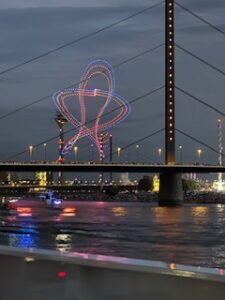
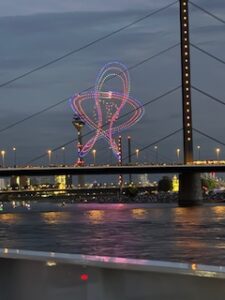
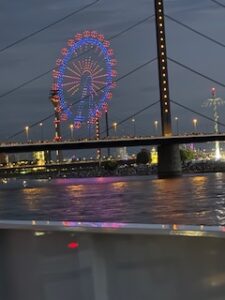
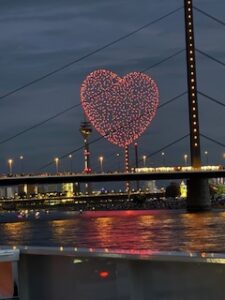
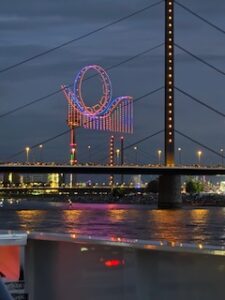
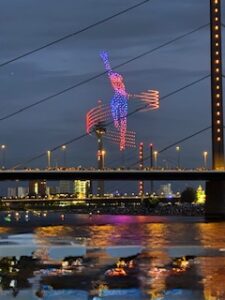
Dusseldorf is a delightful city in Germany located on the Rhine River. While we are here, Dusseldorf is readying itself for the annual Rhine Fun Fair, a summer carnival event which will be kicked off tonight with a magnificent fireworks display. Spoiler alert – it is like no fireworks you have ever seen!
Before I get ahead of myself, let’s back up to a little bit about this important city on the Rhine. It gets its name from Dussel (small river) + dorf (village) or village on the river! How clever.
Dusseldorf is a city of about 650,000 Dusseldorfians, including a very robust expat community of more than 100,000 inhabitants, many of Japanese heritage.
It is a large university town. Education in Germany is 100% free to everyone no matter where you are from and regardless of your residency. The thinking is that once you graduate you will stay in Germany and put that free education to good use on behalf of the good people of this country. It is estimated that about 35% of all students do in fact stay in Germany following graduation. Really, 35% return on your investment is not so bad. I think it is fabulously generous and forward-thinking of the German people. If only I knew of another country that has this same philosophy towards educating.
As I mentioned, we are here during the start of the Rhine fun fair. There are thousands of Germans gathered for summer fun. There will be carnival rides, food stalls and merchants selling all kinds of souvenirs and other foods. The summer fest is most famous for the presence of the St. Sebastianus shooting club. Going back more than 700 years, the shooting club leads a historic procession of more than 3,000 uniformed shooters and marching bands in a parade winding through the streets of Dusseldorf. This is one of the largest parades in all of Germany. We will not be here for the parade but we will be here for the fireworks show tonight!
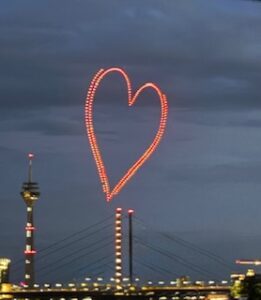
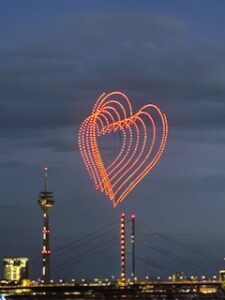
The fireworks show is not the typical rockets and flares. Nope, its a fireworks display made up of DRONES! We watched it from the deck of our ship and it was spectacular. Check out these pictures (which cannot possibly do this display justice). At the close of the display, each drone falls from the sky like a shooting star on its way back to earth, where they all gather back into their drone case. This was truly worth the price of admission. Thousands of people lined the bridges and both sides of the river bank to watch this man-made wonder of lights. We were luck to have a ship as our viewing base.
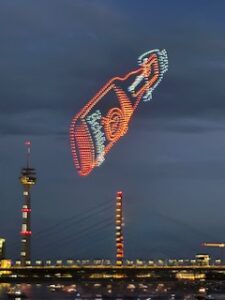
It is hard to imagine anything surpassing this show but the city does a good job of trying!
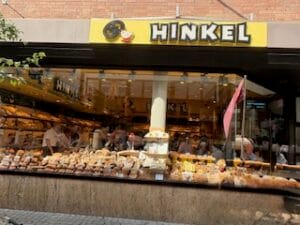 Did you know that there are more than 300 different types of German breads? In Dusseldorf, there is a famous bakery that makes 70+ different kinds of bread each day, in the hundreds of loaves. It is a smallish bakery in the city center and well known to all Dusseldorfians. They start selling their breads early mornings and by noon, they are almost completely sold out. There were people lined up outside when we arrived at 10:30am on a Saturday.
Dusseldorf also has several large (and I mean, large) farmers’ markets selling gobs and gobs of gorgeous produce, flowers, meats and fishes. There are cheese stalls, bread stalls and purveyors of chocolates and candies. You name it, we saw it. My mouth was watering the entire stroll through the market.
Dusseldorf is also known for its mustard. The Dusseldorf brand of mustard is strong, often enhanced with horseradish, smooth and creamy in consistency. It is excellent with sausages, meats, sandwiches, potatoes, eggs, etc. Can you tell we tried the mustard a few times! Lowensenf (Lion’s Mustard) is one of the more well-known brands and has been around since 1903.
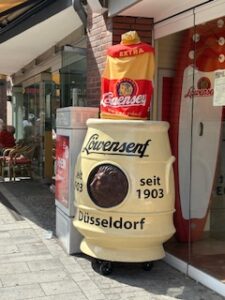
Of course, Dusseldorf has its share of monuments, historical significance and a long, long history. In fact in 1856, the first remains of Neanderthal man were discovered in Dusseldorf, I’m told!
There is also an interesting story related to the Peregrine Falcon. Dusseldorf had a rather large population of these raptors at one time. For reasons no one can explain, they disappeared and were gone from the city for many, many years. Our guide told us that one year, again for reasons no one can explain, a pair of Peregrine Falcons appeared back in Dusseldorf. They nested in the Rheinturm, a 240 meter high concrete telecommunications tower. Today, there are almost 90 Peregrine Falcons calling Dusseldorf “Home Sweet Home” once again. BTW, I googled Dusseldorf falcons and found no such story. So, perhaps our guide likes a good story or the telecommunications company is trying to convince people that there is some good to its imposing skyline existence. I’m going with 90 new falcons in Dusseldorf.
The local beer is Alt Bier. It is a dark lager with a malty and refreshing flavor. It is also slightly hoppy. In Dusseldorf, they are very proud of their lager. You do not order any other type of bier in the Dusseldorf pubs, you never remove your bier from the waiter’s tray and you never, ever order a glass of water or a soft drink. Worst of all, do not confuse an Alt Bier with a Kolsch (from Cologne). They will literally throw you out of the pub. The bier is served cold and fresh.
Our tour started at 10am and the outdoor pubs were filled with people drinking bier. Everyone gets a coaster. You order a bier, the waiter places a mark on your coaster and so it goes for every bier you order for as long as you are there. You tip the wait staff with bier, not money. The staff drinks on the job. The staff is also very crabby (probably because they are really hung over at 9am) and remain crabby until they have drunk enough on the job. I am also guessing that the more you “tip” the waiter, the more likely he is to lose track of how many biers your have ordered. It’s a great system for everyone but the owner of the pub, I’m thinking.
Himself enjoyed a few Alt Biers while we were in Dusseldorf, along with some authentic Bavarian lunch! 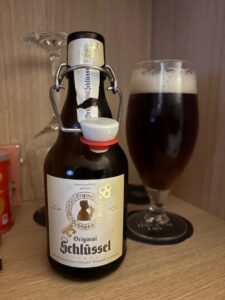
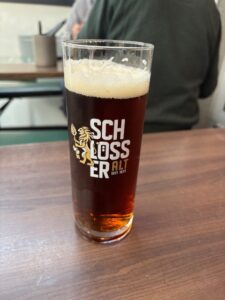
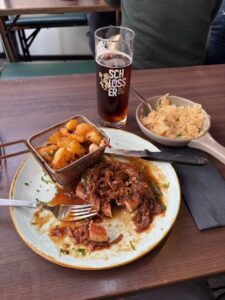
We enjoyed viewing and hearing about the many beautiful old buildings, legends associated with various landmarks and the raucous and vibrant vibe of the city center. I’m a bit worn out talking about churches and city halls so those we enjoyed in Dusseldorf will remain in my notes for now. I found the food, drink and people of Dusseldorf much more fascinating and interesting than the old buildings…
Oh but there are just two more little stories.
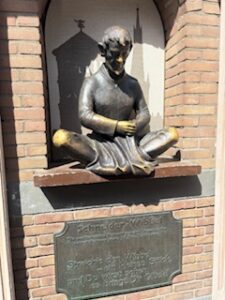
The first has to do with this character Wibbel. Here is the Cliff Notes version of the story of Mr. Wibbel. Wibbel is a drunk and a tailor. While providing services to Mr. Napoleon, he insults Napoleon and is sent to prison. To avoid prison, he sends his assistant in his place! (what a jerk!) The assistant, who everyone believes is Wibbel, dies in jail and is afforded a pauper’s burial. While watching his own funeral, Wibbel declares himself a beautiful corpse (a jerk with a monstrous ego – hmmm, reminds me of someone else). To add insult to injury, Wibbel then pretends to be his twin brother, marries his wife and lives happily ever after. Wibbel is thereby thought to be the luckiest man ever. I’m going with “the biggest jerk” award!
There is a statue of Wibbel tucked away in a building facade and it is said that if you rub Wibbel as you walk by, you will be the recipient of some of that Wibbel good luck! His knees and arms are polished bright by all of the rubbing that goes on whenever one passes his statue. I rubbed his knee in hopes that he bring my knee some good luck!
And the last colorful character I enjoyed “meeting” is Johanna Ey, known as Mutter (Mother) Ey. Johanna had 12 children, 10 of whom died. She later found herself middle-aged and divorced and decided to open a bakery in close proximity to the Academy of Arts, as she was an avid advocate of the arts. Of course, many of her clientele were young student artists. She nurtured and supported many of these students (hence, Mutter Hy), often accepting their paintings in payment of their food/coffee tab. She would also display their art in the bakery for others to buy or she would agree to be painted in exchange for food and coffee. As a result, history has it that her portrait is painted more often than any other woman in Germany! A number of these starving young artists later became famous German painters of the time. Today there is a bakery called Mutter Ey’s and a statue of her out front, paying homage to her and her devotion to the arts.
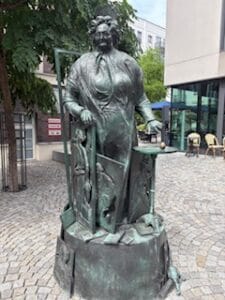
These two characters definitely represent the Ying and Yang of human nature and there is probably a little of each of them in many of us. Maybe that’s why their stories bring a smile to my face?
Now we are leaving the Rhine River and heading down the Moselle River; however, we will return to the Rhine again. So, farewell, Dusseldorf. I hope we meet again!
Cochem (pronounced Co-Guttural H+em)
We were advised that Cochemians do not appreciate it when you mispronounce their city’s name. It is not Co-shem. Take the “ch” and make that guttural sound in the back of your throat. Come on. I know we can all do this – Co eckem. Well, it doesn’t translate well in writing. We can practice when I next see you…
Anyway, Cochem is a small town of about 5,000 people and is situated on the Mosel River. During the season, (May through October), they will accommodate more than 2 MILLION visitors each year! We were told that it is one of the favorite vacation spot of Germans. The town shuts down during the winter and the locals go into hibernation, recouping for the next season.
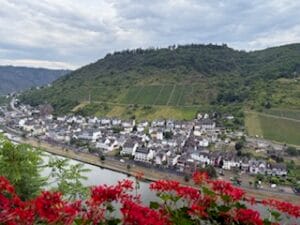
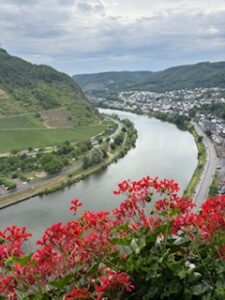
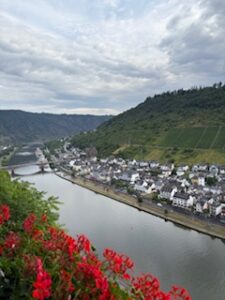
It is a lovely, charming town and easy to see why it is a favorite spot to vacation. There is a beautiful old castle set into the hills, church steeples and picturesque countryside as well as charming German homes all blooming geraniums! Here is what we saw as we sailed into Cochem.
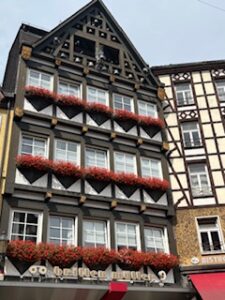
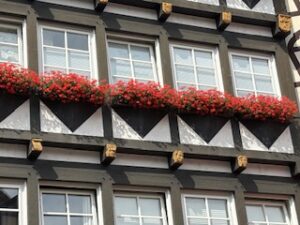
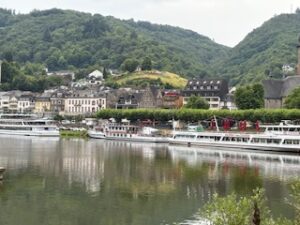
The Castle of Cochem
This is no ordinary castle! It was granted Imperial Castle status in the 1100’s – so it is quite old. As an “Imperial” castle, it is named Reichsburg Cochem. It went through many stages of disrepair, desertion, and destruction. It has a great, modern day story. It sat deserted and destroyed for many years. In the late 1800’s, it was purchased by a wealthy German, Louis Frederic Ravene. He won it in a card game for 300 Gold Mark. I tried to translate this into EU or $$$s and could not find a single tool to help. According to what I did find, 300 Gold Mark is an absolute steal to pay for a castle! So, Louis got a good deal. He renovated the castle, but not in its original Gothic architectural style. Instead, he created a fairy tale looking castle where he and his family lived when in Cochem during the summer months. One little piece of irony, the final “destruction to the castle was the product of Louis XIV of France and it was a Louis who restored it almost 200 years later. Just a fun little factoid to keep in your back pocket the next time you play Trivia!
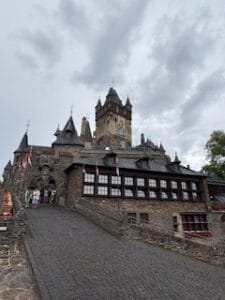
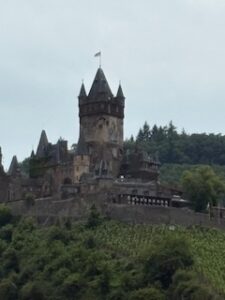
The castle comes complete with a Witches’ Tower where legend has it that women found guilty of witchcraft were thrown from the upper-most window. Remember the poor women who had iron hung around their neck for gossiping? Lots of punishing of the women by rather drastic means. People, have you never met a warlock? Or, a man who gossips? Really gets my inner Gloria Steinem going! Anyway, I digress. Check it out – it’s a long way down!
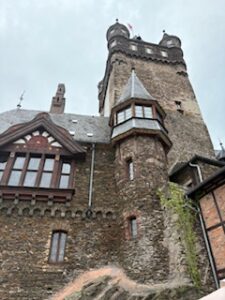
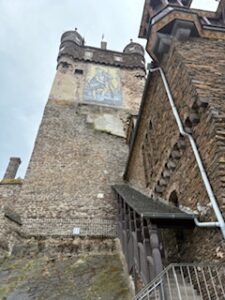
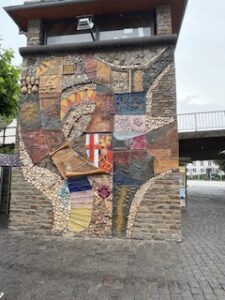
The castle wall on the northside of the castle, has a beautiful mosaic of St. Christopher. St. Christopher is the Patron Saint of Travelers and so the mosaic is appropriate given the 2M travelers who pass in and out of Cochem each year. Very considerate of them to put St. Chris in a position to bless all of us who travel through.
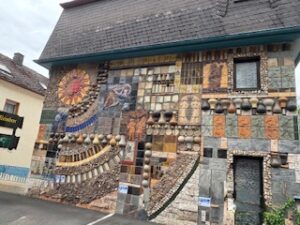
These are more modern day mosaics added during the 19th century restoration’ also very beautiful.
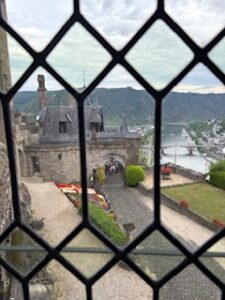
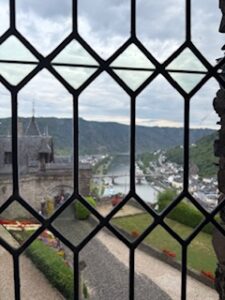
The castle is located 300 feet above the River Mosel and so the views from atop the castle are stunning. There is a sun terrace where you can sit and enjoy a drink and some snacks while taking in the views. It was not a sunny day and so we skipped the sun deck but managed a number of great pics from up high. I love taking pictures while inside the castle to get a perspective from the residents’ POVs. Makes for an interesting story if you imagine being a fairy princess watching for the arrival of her knight in shining armor…. this is what you will see as you wait impatiently for his safe return….
Okay, enough of the castle…
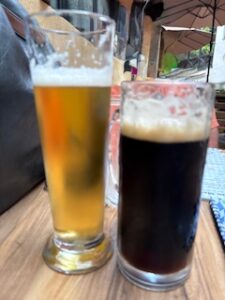
Cochem has a robust shopping area (makes sense considering the influx of tourists every year) and a slew of restaurants serving authentic German food. The sun was out so we sat ourselves down at a lovely outdoor joint and ordered our beers and Jim ordered a stew-like dish for lunch. We were about half way through lunch when the skies opened and down poured the rain. No worries, we ducked into the cafe service area (there was no “indoor” part of the cafe, it was outdoor only) until the rain goes away and we return outdoors to finish our afternoon delights!
Strolling through the marketplace was a great way to spend the afternoon with the locals; plenty of colorful shops, food and beverage stores and a wealth of cafes and restaurants.
That evening, we decided to get off the ship and explore the area for a place to have dinner. We were staying over-night in Cohem so this was a perfect opportunity to leave the “mother ship” and go out on our own. We came upon the Hotel Zur Weinhexen and decided to stop in for dinner. The restaurant was on the top floor, outdoors and had a spectacular view of the river, the castle and the town. The service was great and the food was good. The view, it was a million dollar view!
Berncastle
We were headed for Berncastle, but not really. One of the locks we were to pass through to get to Berncastle was “down” (broken) so a detour was needed. We went to dock in a very, very small town, Treis-Karden. Tour buses would transport us 1-1/2 hours (each way) to Berncastle for our visit. Berncastle is another small town on the Moselle River with a vibrant wine culture. Berncastle is also near to the town of Trier, the birthplace of Karl Marx, near the Luxembourg border and home to the Porta Nigra (a famous Roman gate) and the Trier Cathedral.
I had caught a terrible cold at this point and so we forfeited our tours. No pictures or great stories to share about either Berncastle or Trier. I am confident we will return someday and so, for a future blog adventure will come Berncastle and Trier.
However, we did leave the ship to grab a bite to eat in the town of Treis-Karden, where the ship was forced to dock. There are probably no more than 100 people living in this town. It is really small and really quiet. We managed to find an Italian restaurant that was really lovely looking, with cheery outdoor space and had about 30 customers! What??? Ok, Restaurant La Mula it is! There was not a lot of English being spoken, but that’s okay. Pizza is pizza and spaghetti is spaghetti, regardless the language. So, we ordered pizza and a few salads and a bottle of Chianti and crossed our fingers. Let me say, the pizza was amazing! They had a wood-burning oven so the pizza came out thin and crispy and a little smokey. The salads were fresh and the wine was great, albeit a little warm for our preference. We marveled at our good luck. How is it that we can find such amazing Italian food in Germany, home to sauerkraut, schnitzel and dumplings??? Well, duh, Germany and Italy share a border. The chances of getting authentic Italian food in Germany are a helluva lot better than getting authentic Italian food in Florida!
So, all is well that ends well. We missed Berncastle and Trier but we discovered Restaurant La Mula in Treis-Karden! Now I can guarantee you that we will return!
We are leaving this area and heading back up the Mossel River to return to the Rhine River and continue our tour of Germany. Our next stops are Koblenz and Rudesheim (pronounced RUDE-es-hime), 3 syllables and not 2!
Koblenz
Koblenz is located at a point where the Rhine and Moselle Rivers meet. It is a blend of German and French cultures and is one of Germany’s oldest cities dating back 2,000+ years. The history of Koblenz is fascinating and explains the mix of German and French cultures. More than 85% of the city was destroyed during WW2. An engineer in Cologne was in possession of the original plans of the city and gave the plans over to the Koblenz town in order that they might rebuild their Medieval city, which they did. What a nice story. I wonder how much that engineer would charge for those plans were it today’s market? Believing in aloha as I do, I know the engineer would do the right thing.
Another interesting story about Koblenz, it is home to the promontory point known as the German Corner (see my page on cruising notes), where the Mossel and Rhine meet, and known for the equestrian monument of William I, the first German Emperor. The statue is enormous! The statue has undergone many changes over the years, depending on whether the Germans or the French were in control of the area. At one point in history (late 1940’s), it was completely taken down. When you witness in person how enormous this monument is, it is hard to imagine that it could be completely dismantled. Can you find me in these pictures??
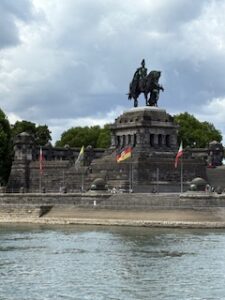
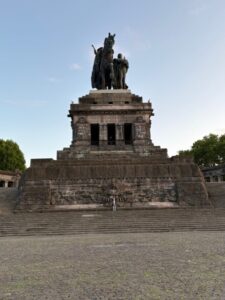
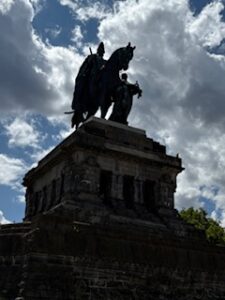
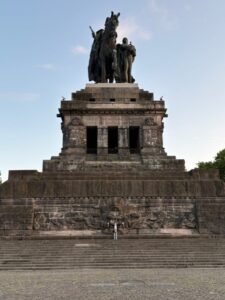
Following the taking down of the Berlin Wall which resulted in the full unification of Germany, it was decided by the city of Koblenz to produce a replica of the original statue (made entirely of copper plates) and install it in the same location as the original. The decision was tied closely to the desire to provide tourist benefits. A wealthy news publisher offered to pay the entire cost of the replica and so the deal was sealed, as they say. In 1993, the new statue was christened.
There are 3 panels from the Berlin Wall that stand next to the monument, dedicated to the victims of the division of east and west Germany. 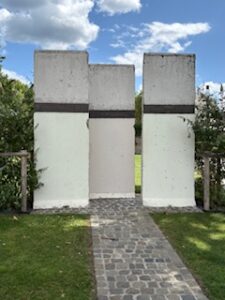
The statue is also surrounded by the flags of the 16 Deutsch states as well as the national flag of Germany, reminding all of German unity. There is also a flag of the EU and of the USA which flies there to show Germany’s solidarity with the US following the 911 attacks.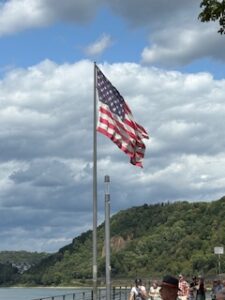
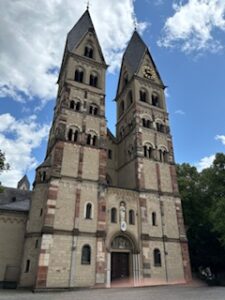
Koblenz is a fairly large city with about 112k inhabitants. It is also a major tourist destination, with many interesting sights and stories. On our tour of the city, we visited the Basilica of St. Castor which dates back to the 800’s, with the present-day building having been renovated sometime in the early 1200’s and 1500’s, respectively. It is a beautiful building with 4 towers and a beautiful fountain out front of the church.
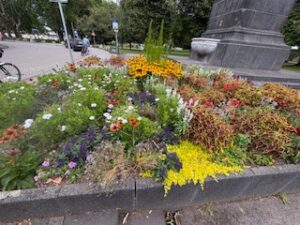
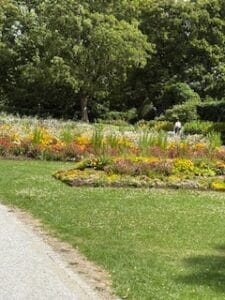
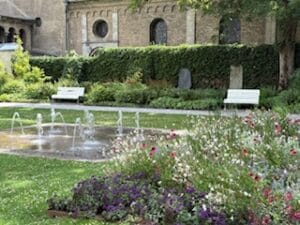
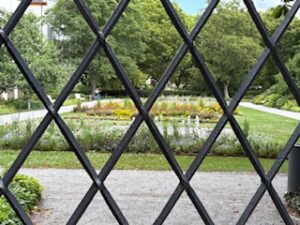
There are beautiful gardens surrounding one of the churches or government buildings, although I don’t remember which one (I admit I glazed over about this point in the tour). I just remember the gardens are beautiful!
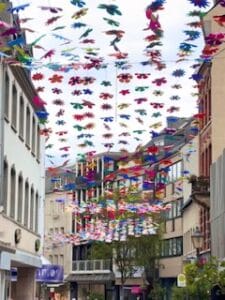
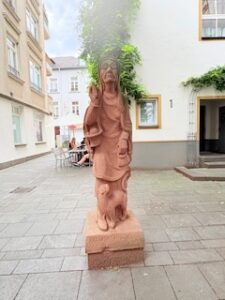
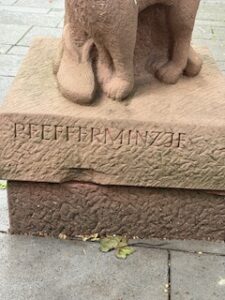
There once was a woman of Koblenz whose name was Peefferminzhe (losely translates to Peppermint). She was a colorful character in town, loved her cigars and Schnapps (probably of the peppermint variety!). Sadly, Peppermint had a bit of a problem with the Schnapps and found herself a pauper and nearly homeless. So, she took to growing peppermint which she would gather up and pack up into small bunches. Her idea was to sell the peppermint to the pub’s clientele which they would vigorously chew before heading home in order to mask the smell of alcohol on their breath. In this way, Peppermint would help the ne’er-do-wells into deceiving the little lady at home. However, remember I told you that Peppermint loved cigars and drinking? Well, as luck would have it, the pub clientele were more than happy to pay Peppermint for her bags of peppermint deception in the form of cigars and schnapps, which Peppermint gladly accepted. Unfortunately, Peppermint did not solve her pauper-status and died homeless but very happy. It is said she is buried in a pauper’s grave with a cigar in her mouth and a shot glass in her hand! (I totally made up this last sentence). To honor Peppermint for her humanitarian nature, a statue was erected near the pubs in question. Like many artists and humanitarians, her fame and fortune came only posthumously. Anyway, good for Peppermint!
Another great story involves little boys and spitting. All throughout the city of Koblenz, there are manhole covers, as well as an adorable statue, depicting a little boy spitting a stream of water from his mouth.
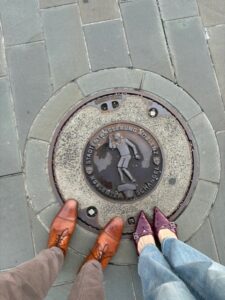 The story goes circumstances having to do with the French occupying this area on and off throughout history, there were apparently a lot of young boys with French DNA but no fathers. Being that bastards had a bad name (hence, bastard is a swear-word), these little boys would be the victims of teasing and much discrimination. So, in retaliation, they would fill their mouths with water from the fountain and whenever possible would spew forth the water from their mouths aiming for the offending Germans. It is kind of a crazy story but these manhole covers depicting little boys spitting are all over the city!
Germany’s largest aerial tramway will that you to the Stolzenfels Castle just outside of Koblenz. We did not have time to manage this trip but have heard that the view of the surrounding area from the funicular and the castle are breathtaking. For another trip!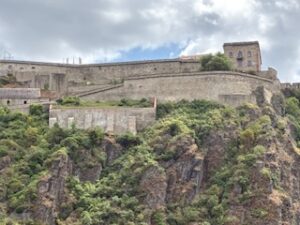
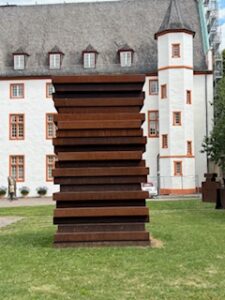
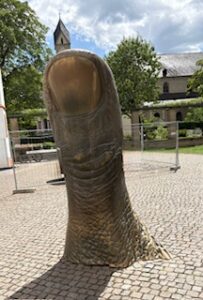 There are a few very interesting little sculptures peppered throughout the city. Most notably, a stack of bronze plates and a very large brass thumb. The thumb is a replica of the one done in 1965 by the famous sculpture, Cesar Baldaccini. It is a famous depiction of the artist’s thumb known as Le Pouce de Cesar and has come to be a symbol of good luck. The original is in Paris.
That evening, we decided to eat dinner off of the ship again. We ate at Wacht Am Rhein where I enjoyed a delicious bowl of goulash soup and Jim had German sausages, roasted potatoes and lots of good German bread. The food was very good and the service was also very good. After dinner, we took a nice long stroll along the riverfront promenade to work off some of that good German food before heading back to the ship for the night. Tomorrow we head to Rudesheim.
Rudesheim
When we docked in Rudesheim, we were immediately charmed by the loveliness of this city. It was so charming! The day we were there, we decided to take a tour fo the Siegried Musikkabinett Museum. We took a little train to the museum and met our local guide who took us through the weird and magical world of mechanical musical instruments. There are more than 400 self-playing instruments. I must admit that I thought this was going to be quite the “snooze fest”. I was very wrong. It was charming and fun and amazing to learn about the many ways in which the music was captured on cards or sheets and then run through the mechanism of the instrument. It really was the beginning of digitalized communication! I would highly recommend the 45-minute commitment to go through the museum with the local guides who work there. You will be enchanted.
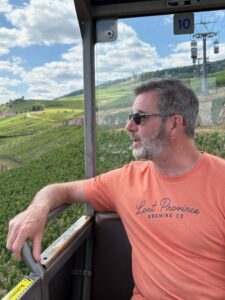
After the museum, we gook the cable car up to the Niederwald Monument to enjoy breathtaking views of the area.
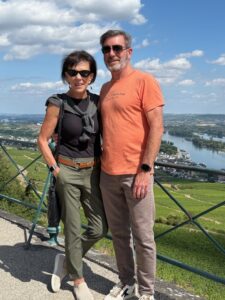
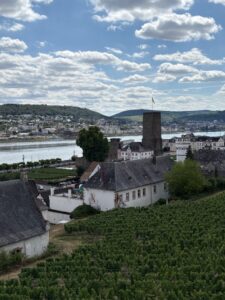
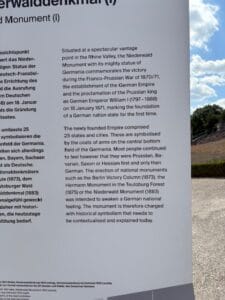
The Niederwald Monument is a sight worth seeing as well. It was built in the 17th century to commemorate the unification of Germany under Wilhelm I. The monument includes a series of story boards erected to tell the history of the monument.
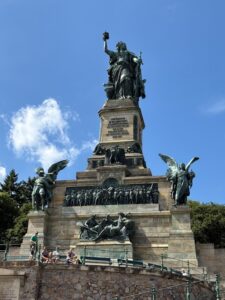
It was a fabulous weather day and a picture-perfect view of the monument, the Rhine Gorge and the surrounding countryside, complete with hundreds of tiered vineyards! The grape grown here is responsible for the Pinot Gris, Riesling and Gewurstraminer, all delicious white wines that run from very dry (trocken), medium dry (halbtrocken) and sweet (kabinett).
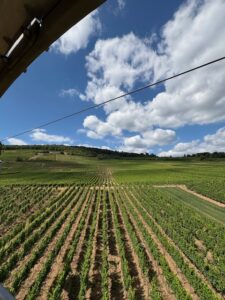
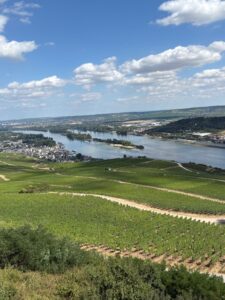
We decided to stroll through some of the lovely streets of this charming town, discovering some interesting little tidbits.
Remember that this city sits on the Rhine. Hundreds of years ago, pre-dams and locks, flooding was prevalent. The locals used Ice Lanes to move about the city during flooding and very bad weather. These were narrow alleyways that connected the eastside to the westside of the old town. These alleyways were either REALLY narrow or we have done some damage to the scale eating 5 desserts a day along with 3 full meals!
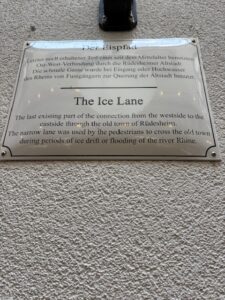
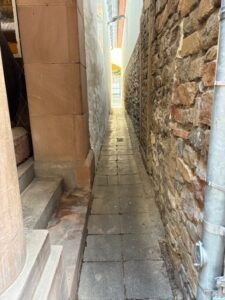
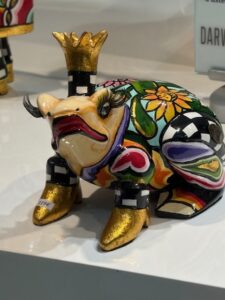
There were adorable shops selling the “latest in fashion”, pottery and leather goods. Aren’t these fun??
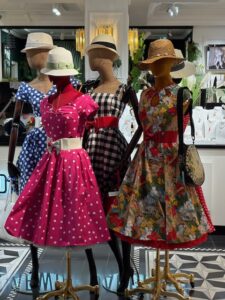
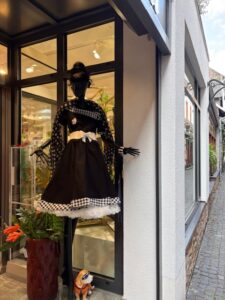
Before having dinner, we ducked into a sweet looking weingarten for HH. It was shaded from the sun by trestles of grape vines hanging over the sides of white awnings with lanterns twinkling and a fountain in the center of the garden gently gurgling away; the perfect setting for some delightful Pinot Gris, trocken of course.
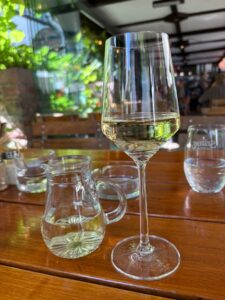
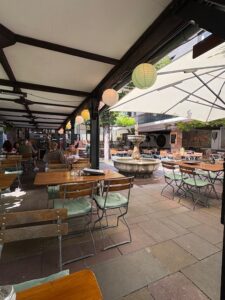
We decided to have dinner in Rudesheim as it is such a lovely town and a nice walk back to the ship. We settled on a fun place called Wirst Haus Hannelore. There was live music and a fun party going on complete with dancing and lots of joyful singing. It was funny because most of the music played by the musician was vintage rock and roll from the 80’s! So in addition to good food, we lucked out on the entertainment and were served by the owner’s wife dressed in traditional German dress. The restaurant has been standing for more than 40 years and was named after the owner’s mother, Hannelore. Worth a visit should you find yourself in Rudesheim.
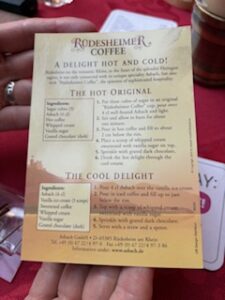
And be sure to treat yourself to a Rudesheimer Coffee – the city is famous for this delightful little treat made up of all of life’s essential nutrients! Alcohol, coffee and whipped cream! I made sure to get a copy of the recipe in case any of our friends at home want to give it a try! What a thoughtful friend…. lol
Heidelberg
Heidelberg is a city in the southern part of Germany with a population of about 120K. Of this number, about 40K are students and 30K are expats! Heidelberg is home to the oldest university in Germany and one of the most prestigious in the EU. It was founded in 1386 and is most renowned for its science program. We did not have the opportunity to visit the University this trip; our tour guide proclaims the campus to be worth a visit so next time we are in Germany, we will make a point to visit.
The other really remarkable site in Heidelberg is the Heidelberg Castle, which is said to be one of the most beautiful and romantic in Germany; this according to our Heidelberg-born tour guide so I doubt there is any bias :). The tour of the Castle is a visit all on to itself and so it too is saved for another visit. One story worth telling however is that in 1764, lightening struck the castle tower where all of the ammunition was stored. The roofs of the buildings surrounding the Castle were made of wood, of course. The lightening strike triggered the “Great Fire of 1764”, which oddly is commemorated each year by a fireworks display using all orange fireworks. Kind of morose, right?
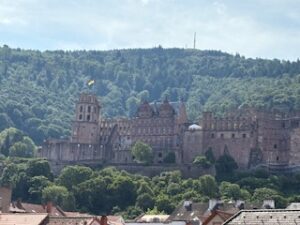
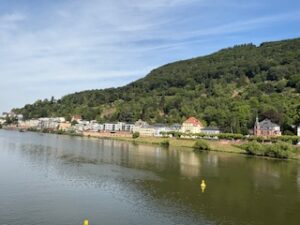
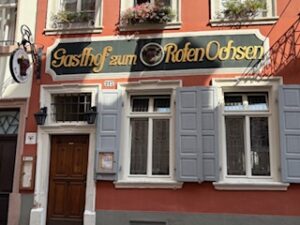
On with the tour. We stopped at the Roten Ochsen Tavern for pictures as it is built in 1703 and owned by the same family for more than 180 years. It is a traditional German restaurant and place of enjoyment for many Heidelberg University student. It has hosted Hollywood royalty such as John Wayne and Marilyn Monroe (surely not at the same time!!??!!??) and war hero, General Patton.
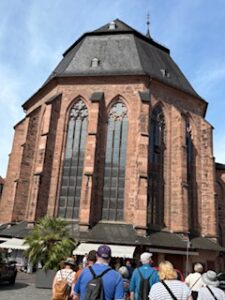
There are a couple of other landmarks of note, namely The Church of the Holy Spirit. The church was built over the span of 115 years (1400-1515). More than 3M people will visit the church in a given year and according to our guide, makes it one of the most visited in Europe. It was originally built as a Catholic church but was taken over by the Protestants during the Reformation. Its history is pretty fascinating having changed religious hands more than 10 times in a 300 year period! What makes it really interesting to me is that a wall once separated the interior of the church allowing both Catholics and Protestants to worship at the same time; not a very popular concept in this Protestant dominated city. The wall was eventually taken down (or maybe struck by lightening? sorry, sick Catholic joke) and the church is reserved for Protestant liturgies these days. Anyway, it’s pretty cool looking and its religious background interesting.
The Karlsplatz used to be a Catholic monestary but was torn down by the Protestants. It was repurposed into a major Christmas market (one of the most well-known) complete with ice rink and one of the longest shopping spaces “in the world” spreading out more than 1 mile with almost 400 shops, give or take a pop-up or two. I will be back as the Christmas Markets is on my bucket list!
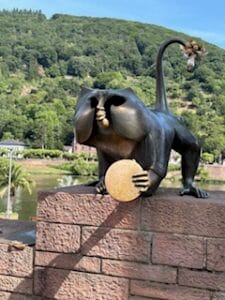
One of my favorite “statues” is the Heidelberg Bridge Monkey, which in its origin has been around since the 1400’s. He sat on the wall of the Old Bridge. Legend is, the monkey sits on the bridge wall to remind those who crossed the bridge from either the city or non-city side to look over your shoulder and remind yourself from whence you came and that you are no better than
Today, the monkey is made of brass (not wood) and its head is hollow with eye holes so you can take selfie using the head as a face mask. If you saw the size of the head, I think you would agree with me that inserting your face to use the head as a mask is a fool’s errand. I could just see my head getting stuck in that little hollow opening! Not that I have a big head or anything…
Today’s version of the legend is that the monkey brings good luck. If you rub the brass mirror that he is holding, you will be rewarded with a large sum of money (notice how “polished” that mirror is!). If you rub his fingers, you will be guaranteed a return trip to Heidelberg and if you touch the 2 mice near the monkey, you will be “blessed” with lost of kids and grandkids. Whether any of these bring you good luck depends of course on your definition of “good”. Just sayin!
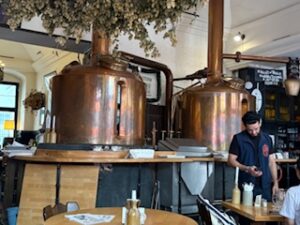
Enough of the monkey and off to Brauhaus Vetter! It is located in the center of the old city and a favorite spot of students and tourists. The beers are handcrafted and brewed on site. In 1994, the Vetters was recognized in the Guinness Book of World Records for its Vetter 33, the strongest beer to have ever been brewed as of that time. It weighed in at a hefty ABV of 10.5. This is “child’s play” today but in 1994, it was noteworthy for sure.
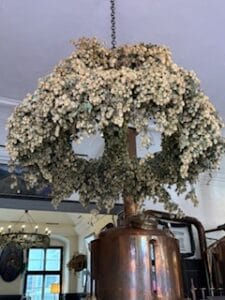
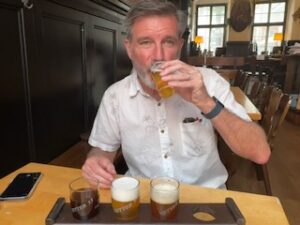
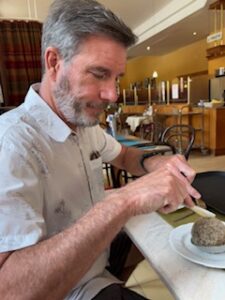
Jimmy tried a flight of their handcrafted beers, none of which were the Vetter 33, and reports them to be quite good! He also sampled one of the well-known Schneeballen, a ball shaped pastry, deep fried and coated with sugar, chocolate and other sweet delights. The Schneeballen sounded a bit on the disgusting side to me so I refrained from sampling them. The beer however was a thumbs up from me as well. Check out the chandelier made of hops!
On the topic of food, Heidelberg is also famous for its Student Kiss (Studentenkuss) chocolate. Made of fine German chocolate and still produced in Heidelberg, it has a cute story. Cafe Knosel was a gathering spot for the young ladies of the time who attended the nearby finishing school. They were always accompanied by their governess chaperones. The presence of the young women naturally drew the male students of the University to the cafe. However, thanks to the chaperoning governesses, the young men didn’t stand a Schneeballen’s chance in hell of getting close to the young women. So, the proprietor of the cafe, Herr Knosel, created the Student Kiss chocolate. He sold it as a token of affection to be given to the young lady by the gentleman interested in her affections. It also proved to be a very clever way of passing messages to the young woman. See, the man would purchase the candy, unwrap it and write a message to the young woman, most likely declaring his undying love. He would then rewrap the candy and give the candy to the young woman as an “innocent” display of interest. The girl unwrapped the candy, read the message cleverly disguised on the wrapper and enjoyed her chocolate at the same time while signaling her acceptance of the boy’s attention; all under the unsuspecting nose of her governess! The bad news is, the young woman did not have to accept the candy and if she didn’t, well then the poor schmuck was out his money for the candy and bitterly rejected. I wonder if that was then the origin of “bitter chocolate”???
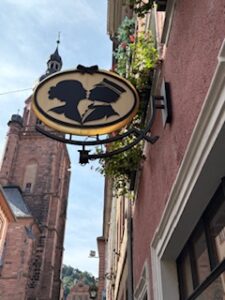
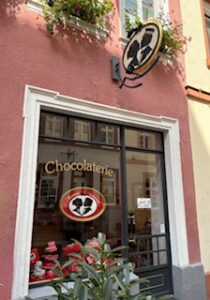 The store is as adorable as the story of the store. Unfortunately, I received no message from a certain someone declaring his undying love for me. Hmmmm…. So, it is time to kiss Heidelberg farewell as we are off to the city of Strasbourg. Hopefully, Strasbourg has a good story which will prove more beneficial to moi.
Strasbourg
Strasbourgh is in the Alsace region found in the eastern part of France. It has a very “German” sounding name and so I was surprised to learn that it is located in France. French and German are the primary languages, with English a distant third.
Strasbourg is a very large city. It is also home to a well-known university and an incredible cathedral, The Notre Dame Strasbourg. Our tour was focused primarily on the Cathedral, with some ancillary information included on the city. The fact is, you could easily spend 3+ days in Strasbourg; longer if you chose to explore the region of Alsace. The wine tasting alone would eat up a week of time given the prominence of this wine growing region and its importance to the French economy and history.
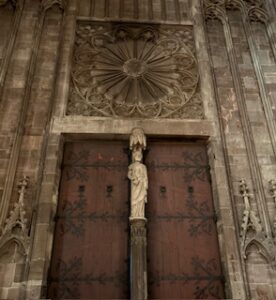
The Cathedral sits in the center of the plaza and is an imposing figure. In the 17th and 18the centuries it was considered the world’s tallest building with a tower that is about 500 feet high. Looking at the Cathedral is overwhelming. The intricacies of its Gothic carvings, Romanesque arches and the combination of the two styles is jaw dropping. That’s before you even get inside the place! It is enormous. It is ornate. It is overwhelmingly beautiful. Wiki reports that the Cathedral is listed on the UNESCO World Heritage List along with the center of the old city for its outstanding representation of Gothic architecture. These pictures do absolutely no justice to this wonder and represent only a fraction of the pictures we took of this one site!
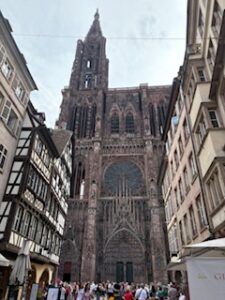
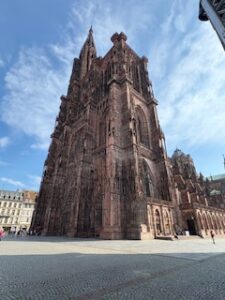
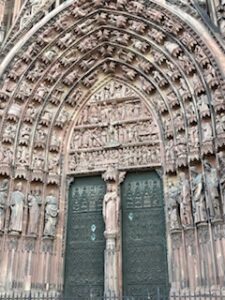
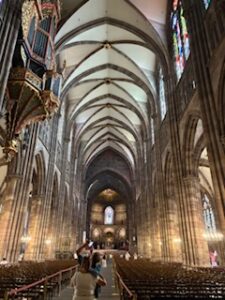
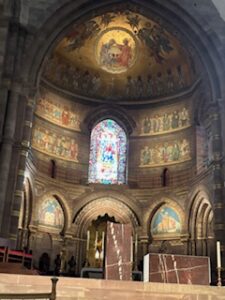
And the stained glass was to die for!
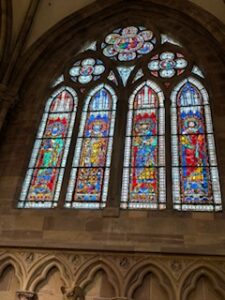
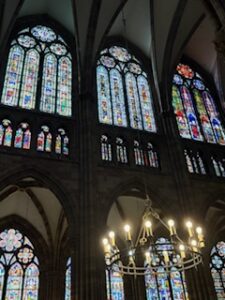
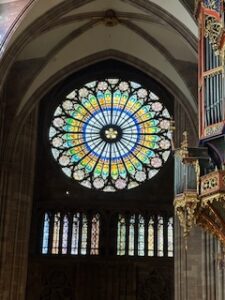
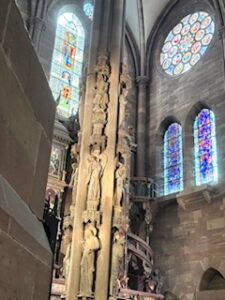
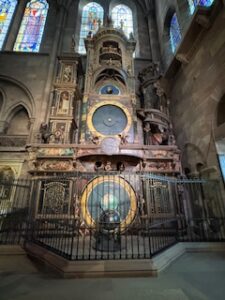
One of the most astounding things I have ever seen is the Astronomical Clock in the Cathedral. It is still 100% functional and to me, mind-boggling evidence of the brilliance of the human mind. The clock includes a perpetual calendar, planet dial, solar and lunar eclipses and the actual position of the Sun and the Moon. The real show stopper are the figures of Christ and the 12 Apostles and the procession of same at the solar noon every day. We just missed their procession. However, we did see the mini procession of the figure that goes through the cycle of life during the coarse of the day. We saw the figure pass from 1st to the 2nd life cycle.
I would love to come back in a month’s time and observe how the position of the sun and moon have changed, or sit through the 4 cycles of life.
What an amazing feat of engineering.
Our tour of Strasbourg ended at this point and so Jim and I spent the next 5 hours just roaming around the old city and having lunch. We ate at a locals hang out recommended by our tour guide. I will leave the name of the place in my memory. The food was just “ok”. The menu was not in English and so I ordered the “salat”, thinking I would get a traditional salad. What I ordered was not a “salad” in the traditional American sense but rather a mixture of 1 ton of Gruyere cheese combined with one half of a pig in the form of very anemic looking sausage. GAG ME WITH A SPOON!
However, all was not lost. Following lunch, we found a store that no French city would be without: Macaroons! Sweet Baby Jesus, I have died and gone to Heaven!
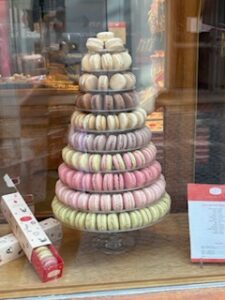
After Dessert, with a capital “D”, we roamed around and took pictures of the beautiful views and some adorable houses that looked like something right out of a Grimms’ fairy tale.
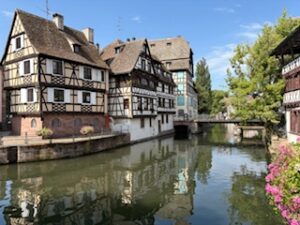
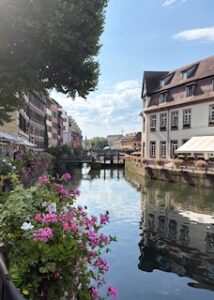
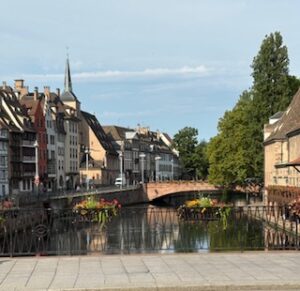
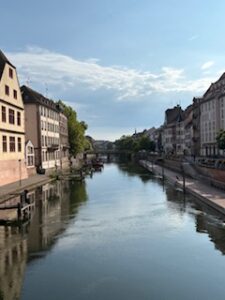
The last “fun” thing we saw was the local EMT squad doing their weekend Water Rescue drill in the canal in the old city center. How fun to see the locals at work!
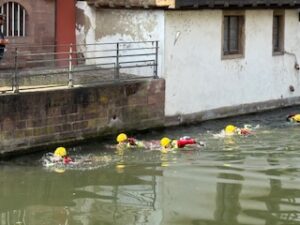
As I mentioned, we could easily have spent 3+ days in Strasbourg and hope to do so in the near future. In the meantime, it’s time to head back to the ship and ready ourselves for our final stop on this 15 day adventure.
Breisach
Breisach is a small town located between the Rhine and the Black Forest, not too far from the city of Freiburg. Breisach is a food and wine destination (our kind of place!), sharing its border with another heavy hitter in the wine & food space, the Alsace region. Breisach was almost completely destroyed in WWII but with love and determination, its citizens rebuilt it complete with cobblestone streets and delightful and colorful houses.
We opted to bypass a tour of Breisach and elected instead to visit the wine growing region of Kaiserstuhl. The landscape is covered in tiered vineyards, most of which grow the grapes for the area specialties, Reisling and Grauburgunder (German Pinot Gris). Thanks to volcanic eruptions millions of years ago, the area is blessed with loose volcanic rock and a temperate climate, making for the perfect terroir for these wines.
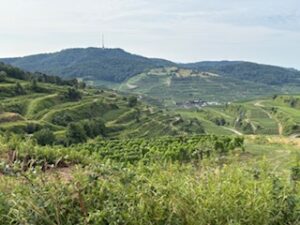
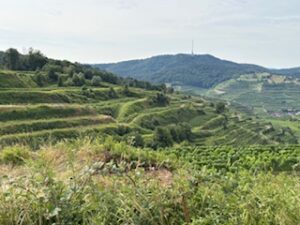
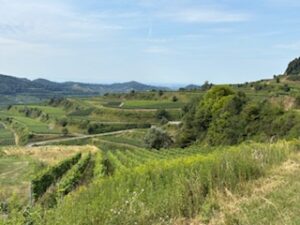
Because the area is almost exclusively small vineyards, most of these have come together to form winery cooperative. We paid a visit to one of the larger cooperatives in the area and were treated to a historical view into the area, the cooperative and a sampling of 6 of their finest wines. Each was more than worthy! Our winery host was both entertaining and a font of knowledge, having been a contributor to the collective for more than 40 years.
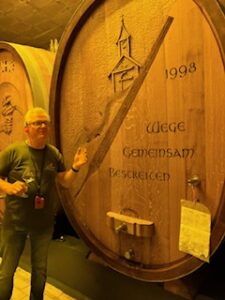
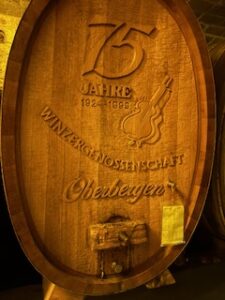
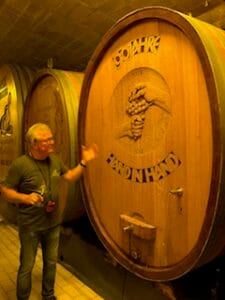
Since experiencing the wines of Germany, Jim and I are big fans of the dry and medium dry Riesling; they are not to be dismissed as the sweet, rather thin samples of our youth! In fact, we carried some home with us and look forward to tasting them in hot, sunny Florida. Prost!
Farewell and some final thoughts
I know very, very little about my heritage other than my maternal relatives are German. I decided to learn more about my heritage and have been on this quest for over a year. Just before embarking on this journey, my friend Ursula (of Munich), helped me to obtain the birth records of my maternal grandparents, both from the Black Forest region of Germany. The left Germany in the early 1930’s and headed for the USA.
The records also contain information on my great grandparents, about whom I knew nothing prior to Ursula securing these documents for me. It was very special to travel through Germany, and particularly this Black Forest region. I am looking forward to continuing my research when I return to the USA. Hopefully, I will find myself back in Germany when I have learned much more, so as to visit the sites where my maternal ancestors lived before emigrating.
Until then, Auf Wiedersehen, my dear Germany! Tomorrow we disembark and head to Switzerland for 3 days in Basel before heading home.