Amsterdam
Amsterdam is the first stop on our 3-week river cruise experience. Since we have never visited The Netherlands, we decided to spend a few extra days in Amsterdam before boarding the ship.
Usually, the weather is mild here. The week before we arrived, it was 98 degrees and the river levels were quite low, threatening the itinerary of our river cruise. Hope springs eternal, however, and when we landed, we were met with rain and chilly temps. No worries. It is all about the “aloha”.
As we were tired and jet lagged, we decided to take a taxi to the hotel rather than public transport (which is excellent in Amsterdam). Spoiler Alert: do your research before you approach the taxi stand. The taxi driver quoted 85 EU for his ride because he told us he had to take a long route to avoid construction traffic (taxis use meters here so the longer the ride, the higher the meter price). it sounded like an outrageous price to us, and we questioned it but were too tired to argue. I got in the cab and quickly checked Uber. Uber was quoting 40 EU for the same ride. Lesson learned – check Uber before you hit the taxi stand!
We headed to the hotel and were very happy to find a lovely old building completely restored and updated but without losing its charm. The hotel, The College Hotel Amsterdam. The hotel is housed in a historic college building. All the rooms, which at one time were dormitories, have been remodeled with all the creature comforts installed. The rooms incorporate school themes; for example, the nightstand is a former desk with a report card and class notes inlays. The hotel is charming and sits on a beautiful, tree-lined street in a very hip Amsterdam neighborhood. This trip is off to a great start with this lovely accommodation.
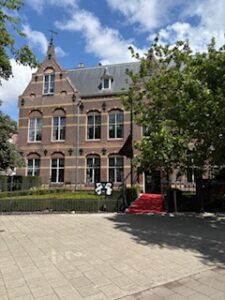
After a quick nap to shake off some of the jet lag, we headed out to explore the city.
Amsterdam is the capital of the Netherlands and one of its largest cities. It is a city of canals and bicycles (more on the bicycles later). Just a quick word of caution. If you get to Amsterdam before I cover the bicycle culture, bicycles have the right-of-way, and you do not mess with the bicycles.
The canals located throughout the city, giving it the nickname The Venice of the Netherlands. In doing our research, we learned there is much historical significance to the canals. They came to be one of the main reasons for the economic success of the Netherlands, making it a shipping and maritime giant in the 1600 – 1700’s (I did not check Wiki on this date so do not quote me!). I mean, who has not heard of the Dutch East India Company?? Unchanged: The canals located throughout the city, giving it the nickname The Venice of the Netherlands. In doing our research, we learned there is much historical significance to the canals. They came to be one of the main reasons for the economic success of the Netherlands, making it a shipping and maritime giant in the 1600 – 1700’s (I did not check Wiki on this date so do not quote me!). I mean, who has not heard of the Dutch East India Company??
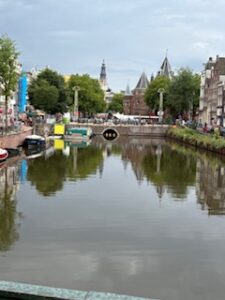
We did not see a lot of spice trading or high-seas adventures going on, but we did see lots of people hanging out on boats enjoying cocktails as they cruised up and down the canals running through the heart of the city. We had such an adventure booked for earlier that afternoon; unfortunately, it was foiled by the rainy weather. In any event, it is worth doing your research on the importance of these canals before heading to the Netherlands. Or just get yourself a good tour guide shortly after you arrive and skip the hours of internet trolling.
We continued our Amsterdam exploration by heading out to visit the streets with the famous Damrak Canal Houses. We had seen pictures of these colorful houses and thought they would be interesting to see up close and personal. The houses were built sometime in the 17th century. They are tall and extremely narrow and appear to be connected to one another. The width of these houses is not an accident. Back in the olden days, you were taxed on the frontage width of your house. So, the thinner the house, the lower the taxes. Turns out we humans have been trying to outsmart the tax man for many, many centuries. Given these houses sit on prime water-front land, not sure their width is still a major function of their property taxes but that is a subject for a different kind of blog.
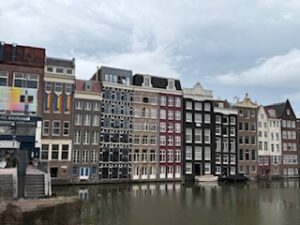
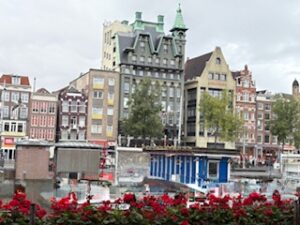
While admiring these houses, Jim and I noticed several interesting tidbits. First, several of the houses resembled the Leaning Tower of Pisa. In fact, they appear to be propping each other up! Neither of us is an engineer but we assume that the buildings are shifting because most of the city is below sea level and over time, the land on which they sit is eroding. Again, not engineers, but a reasonable assumption. Look closely at these pictures and you can see the buildings leaning forward!
The other thing we noticed is that up near the top of every house is a beam that juts out from the house. In some cases, there were huge, heavy ropes dangling from the beams. Guess why? The houses are super narrow. The staircases leading up to the 2nd and 3rd floors are also narrow. Therefore, getting furniture and other larger deliveries up to your 2nd or 3rd floor apartment is not possible via the stairs and there are no elevators. So, if you buy a new couch, plan to have it hoisted up to your 3rd floor bedroom via a large rope that will carry it from street level up to the very large windows of your bedroom! Again, not an engineer. I just found this simple solution to be brilliant and wished I could have witnessed the UPS person delivering a package to the upper floor!
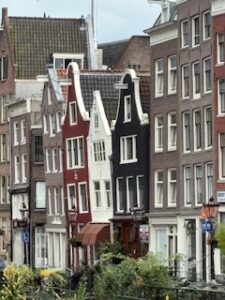
So do not miss seeing the Damrak Canal Houses. Special bonus, on your way to/from, you will experience many other interesting spots in Amsterdam; for example, the infamous Red-Light District, Dam Square and the Royal Palace, to name a few of the more memorable landmarks.
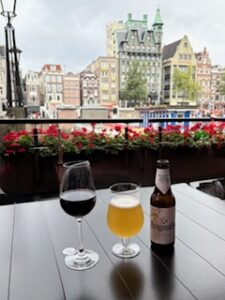
There is a great little bar where you can sit outside and watch the world (and people) go by called The Grasshopper. Nothing special except that it sits on the large canal just before you enter the Red-Light District and is GREAT for people watching. I highly recommend a Happy Hour stop before heading off for dinner.
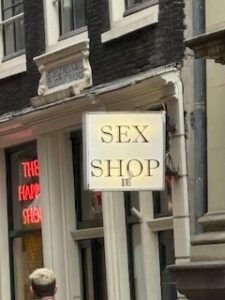
The Red-Light District is exactly what I expected it to be. Seedy, lots of “sex shops”, windows with half-dressed individuals (live) on display and a lot of drunk and rowdy humans of various ages. Very little “class” to the place. I went, I saw, I shall not revisit.
We had dinner at the Mata Hari restaurant as we had heard it was a great place to eat. It is on the edge of the Red-Light District and named for the famous Dutch exotic dancer who was also said to be a spy. It sounded terribly exotic and so we thought we would give it a try. Being near the Red-Light District, we felt sure that the people watching would be worth the visit. The food was decent; we had a nice glass of wine with dinner and prices were reasonable. Further, the people watching was top-notch!
Day 1 came to an early end as it was time to shake off more of that jet lag. Besides, it was starting to rain in earnest and being wet and tired are usually not a good combo. Good night, Amsterdam.
We began DAY 2 in Amsterdam with a stroll through the Albert Cuyp Street market in the Latin Quarter of Amsterdam. It is walking distance from our hotel, and we had read that it is a vibrant and lively street market, all words that are part of our vocabulary!
The market is named after a famous 17th-century painter, Albert Cuyp. It is like a giant farmers’ market filled with fresh produce, cheeses and meats and fish. There are food vendors, clothing booths, household goods and lots of kitschy souvenirs. It spreads out over several city blocks, and you really can find almost anything you could possibly need.
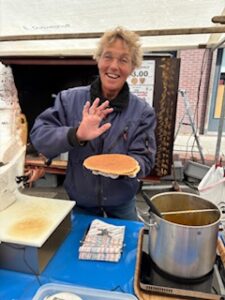
We had planned to have breakfast at the market and were delighted to find several vendors selling Stroopwaffels, which are waffle-like delicacies as thin as a crepe. They are sliced in half (which is an art in itself given these are crepe-thin!), spread with something amazing like Nutella or maple syrup and joined back together to form a wafer-thin sandwich. Our Stroopwaffel vendor was very happy and very proud of her craft. Rightfully so! We found these to be delicious – the breakfast of champions!
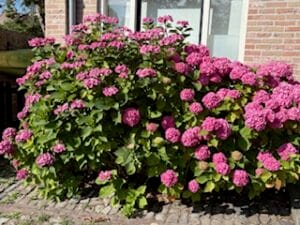
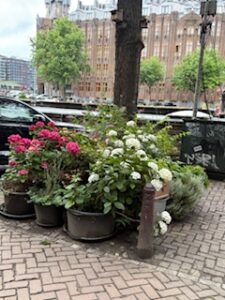
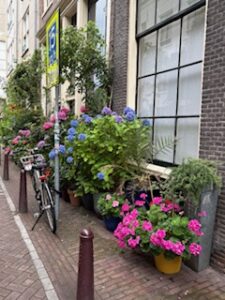
As we walked through these neighborhoods, we saw the most beautiful gardens. There were flowers in full bloom everywhere we looked. The landscape was stunning – just look for yourself.
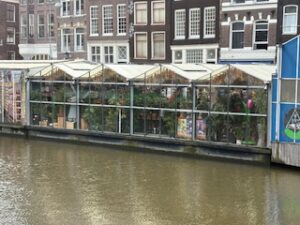
Speaking of flowers, there is a famous market called Bloemenmarkt, which I just had to see. So, promising a stop at a local brewery, Jim and I head off to find Bloemenmarkt. This market is special because it is a floating market! Each market stall sits on top of its own floating barge in one of the large Amsterdam canals. It dates to the late 1800’s, when the flowers arrived daily from the countryside by boat. The flowers are just beautiful. I had to buy some tulips, certified transportable to the US, of course. It is a beautiful and picturesque place for a leisurely stroll while you enjoy the gorgeous blooms.
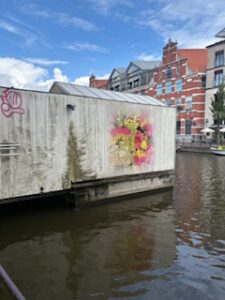
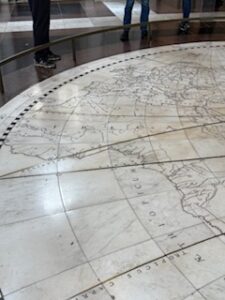
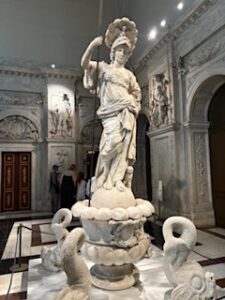
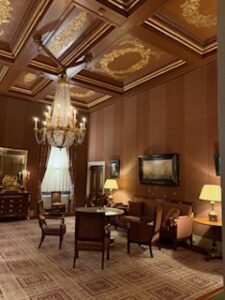
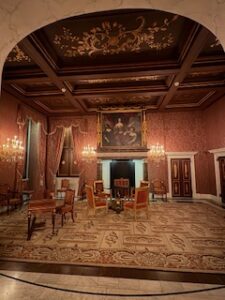
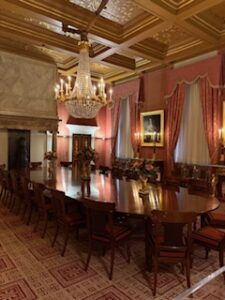
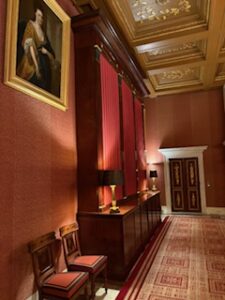
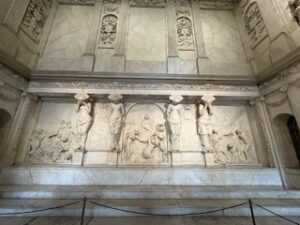
Next stop is The Royal Palace located in Dam Square (then, the brewery, I promise!). Dam Square is located in the center of the city and home to such cultural attractions as the Royal Palace, Madame Tussauds and the National Monument. We chose to visit the Royal Palace as our time in Amsterdam is limited. We chose a self-guided audio tour that hit on the highlights. The palace is still used for important state affairs, such as entertaining important heads-of-state. When in use for these purposes, it is closed to the public. Otherwise, it is open for all citizens and visitors to stroll through and admire the beautiful dining rooms, salons, the impressive dining hall and many original works of famous Dutch artists. It is worth the visit. The “express tour” lasts 35 minutes and touches on all the most important attractions of historical and present-day significance.
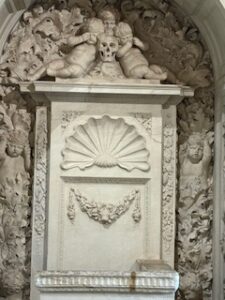
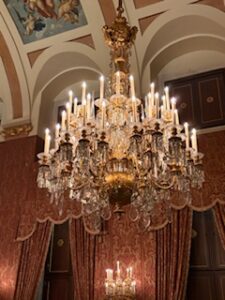
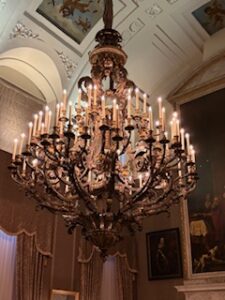
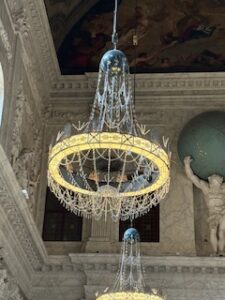
Represented here are the Great Hall, visiting head of state sitting rooms, the State Dining Room, the Red Salon, The Punishment Room (note the skulls) and some beautiful chandeliers that I just randomly included because they are so stunning!
Okay, off for lunch and a local brew (or two), destination FoodHallen.
FoodHallen is a food market housed in a converted tram depot. There are a dozen or more food stalls with every kind of food imaginable: pizza, sushi, tapas and Vietnamese foods and you can sample the famous Dutch dish, bitterballen (that does not sound very appetizing to me). There is something for whatever your taste buds are feeling that day. Most important, there are several brew stalls serving local craft beers. You can grab your food and brew and enjoy your meal at one of the communal tables in the center of the hall. It is a fun, noisy and hip place to hang out and enjoy good street food and the local brews. A must-see on our itinerary.
As our time in Amsterdam draws to a close, we head back to the hotel to gather our luggage and head to the cruise ship for our first night of cruising. We are off to see the rest of the Netherlands!
Utrecht
Days 2 and 3 find us visiting 2 very different cities; Utrecht and Veere.
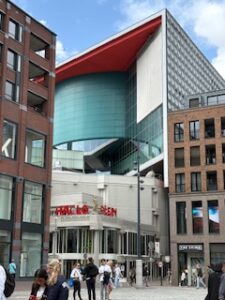
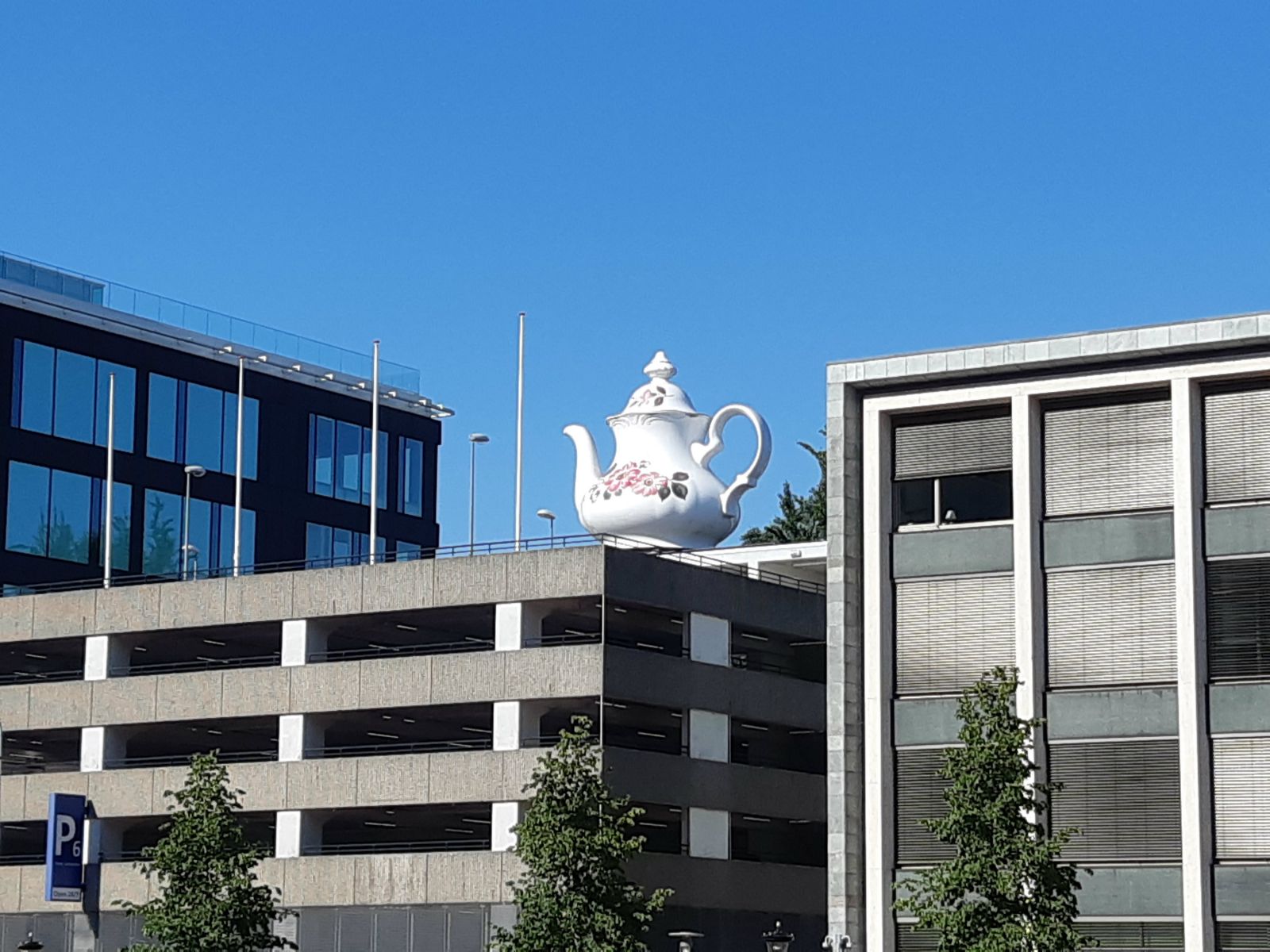
Utrecht is a large city – about 375,000 inhabitants. It is a city of canals, a university town and an interesting mixture of the old and the new. When we first enter the city, we are greeted by a huge modern looking building which turns out to be a gigantic shopping mall. Not what one would expect from a very old city, is it? I was a bit disappointed to be honest as I was looking forward to things more representative of the Medieval and Dark Ages – not giant shopping malls! Or giant tea kettles on roof tops?
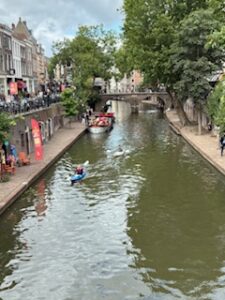
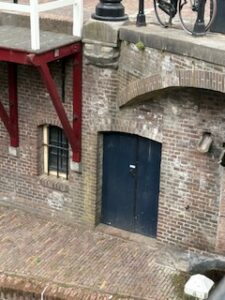
As we move past the shopping mall we are treated to lovely canals meandering through the old part of the city, on which people are paddling or enjoying cocktails and apps. My kind of boating! Along the canals are houses and at their canal-level, each has a cellar door. These are dry cellars which were built to facilitate the transfer of shipped goods from the canal to the house or business where they could then be stored and transferred to the upper floors of the home or business when needed. These are still in use today.
The city has its share of imposing cathedrals and lovely old buildings, of course.
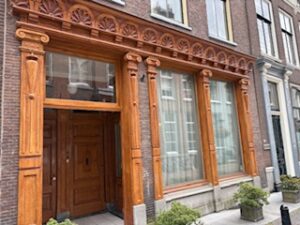
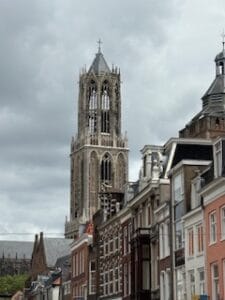
Check out the doorway to this building – it is all hand-carved wood. It is really quite beautiful and the picture does not do it justice. In the background is the tower of the cathedral, which is now a museum.
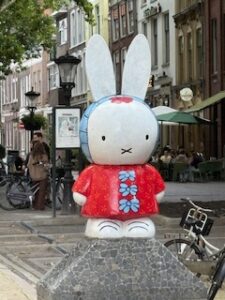
Let’s not forget the plethora of statutes of historical significance. This is where my short attention span kicks in as I cannot ever possibly remember why I took a picture of a particular statue. Oh well. They make nice photos!
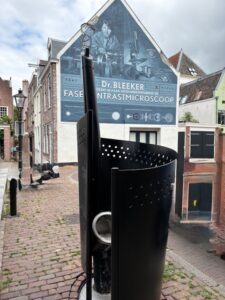
One of our most favorite sites is the public urinal (for men only), which is conveniently located in the middle of the area filled with brew houses and cafes! The women were probably not allowed in these establishments and so public urinal accommodations for women were moot. Please do ZOOM IN on the top of the urinal. A public advertisement at its most basic and functional. They do say that pictures are worth a thousand words!
Veere
By contrast, Veere is a very small and charming village-like city, dating back to the early 1500’s. There are only about 16,000 residents and it sits right off the North Sea. It is a thriving resort town for many Europeans looking to escape the summer heat. The marina is filled with boats and sandy beaches amongst the old buildings that line the main streets of Veere. This is a place we both agreed that we could live. The marina is now the entrance to a lake supporting sailing and fishing; however, it was once an arm of the North Sea. Which brings me to the Delta Works.
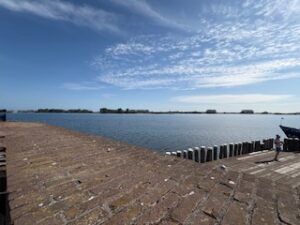
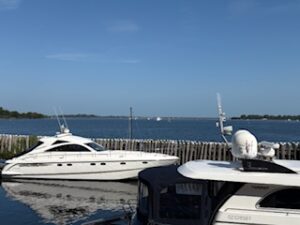
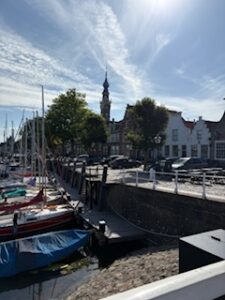
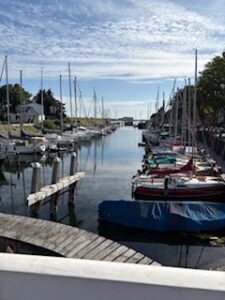
This area was nearly destroyed by a terrible flood in 1953. This flood led to the development of the Delta Works, an multi-country effort using dams and dikes to protect the area from the ravages of the North Sea. One can visit the Delta Works when visiting Veere. We did not do so on this trip but by all accounts from fellow passengers who did visit, it is well worth the time and effort to see these marvelous feats of engineering. Next trip…
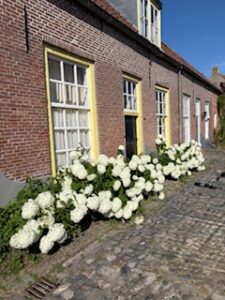
The houses along the main street maintain their original charm. Many of them are undergoing serious rehab work; however, they are all protected as historical sites and so only the interiors can be changed. Thank you for that!
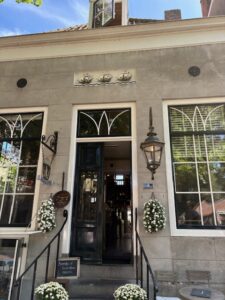
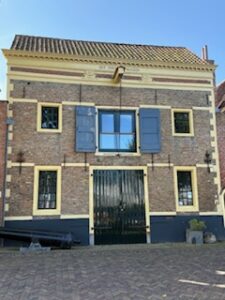
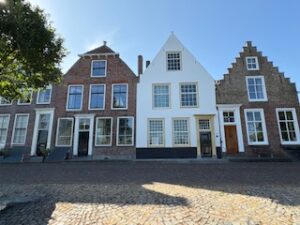
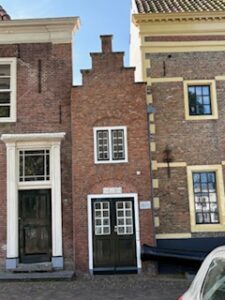
In this picture, take a look at the smallest house perhaps every built!
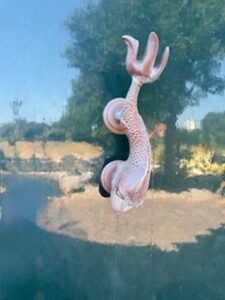
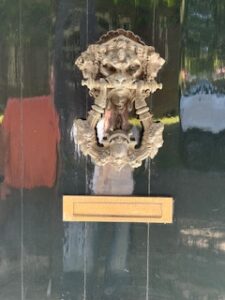
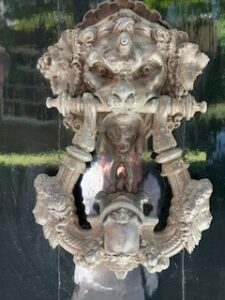
Jim and I are both Door Knocker geeks and love to admire these functional and ornate additions to the front door. We found some really interesting examples in Veere…
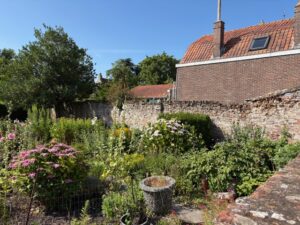
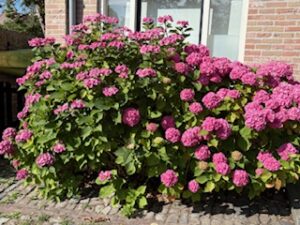
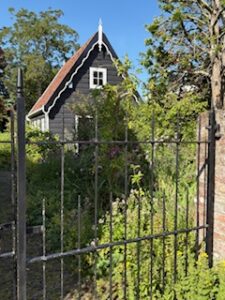
We also had the chance to meander through small, cobblestoned streets in Veere, where we were treated to lovelt garden settings.
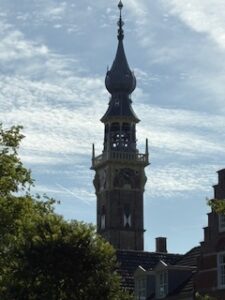
No town would be complete without its cathedral and Veere is no exception. The large church was transitioned to a hospital by Napolean and later closed. A small part of the church remains open as a museum but the majority of the church is not in use today. It’s beautiful tower still graces the perfectly blue sky!
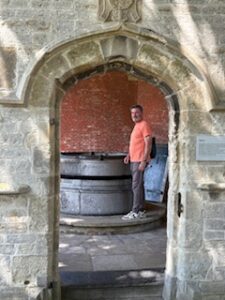
There is also an old cistern, which was fully functional until 1938. It brought 200,000 litres of clean water to Veere and was the primary source of water for every household. In 1938, water was brought to homes via pipes installed in every house. Technology…
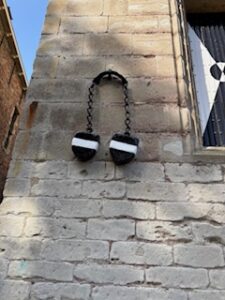
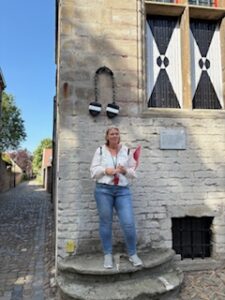
Now every one loves a bit of misogyny, doesn’t he? History has plenty of examples to share and Veere is no exception. In front of the City Hall there is a pedestal and attached to the wall of the building is a medieval device made up of a heavy iron chain, from which hang 2 very heavy blocks of iron. This device was used to punish women who gossiped (because men never gossip!). The woman would stand on the pedestal and the chain would be hung from her neck with the 2 iron blocks resting on her chest. She would be made to stand in this public square thus encumbered for however long the ruling male magistrate deemed appropriate for her gossiping sin. Imagine!
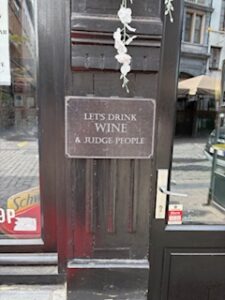
Now this approach seems much more representative of today’s culture, doesn’t it? Again, a unisex approach, I think! (By the way, this is a sign from a building we visited in Antwerp, more on this later).
Life in Veere is said to be slow and easy. Residents have a “whatever” attitude towards life. I would say they epitomize the Aloha spirit. Nothing exhibits this more than their main clock tower, which has only one arm. So, at 10 o’clock for example, it chimes 10 times. No one know the exact time again until the tower chimes 11 o’clock. In between, the residents will tell you, “oh well, it is 10-something”. No need to know the exact time! Enjoy life and don’t worry about it. While your at it, grab a coffee and a boulis (a local delight that resembles a cinnamon roll topped with loads of gooey icing!).
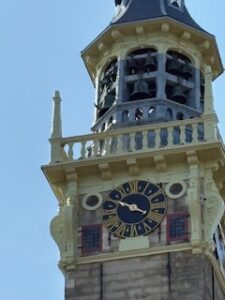
Veere seems to have a firm grasp on what should be one’s priorities. We like it. Aloha Veere!
Nijmagen
Our last stop in the Netherlands is Neymagen (pronounced ny-may-gen). It is one of the top 10 largest cities in the Netherlands and one of the oldest, having celebrated its 2,000th birthday in 2005, making it 2,030 years old this year. It is on the Waal River and very close to the German boarder. It is a large university city, made up of mostly medical students.
The city is well known for its 4-day Wellness March which takes place every year in late July. The International Four Days March is a really big deal here. More than 40,000 marchers will take part in the event, which brings more than 2M people to the city of Nijmagen. It includes 4 days of parties, eating, drinking and music until all hours. So, why is it called a Wellness March? Well, men must march a minimum of 31 miles each day and women much march a minimum of 24 miles each day. Yes, that is EACH DAY! So, about 47,000 of the 2M will be “well”. The other 1,950,000 are steeped in bad food, lots of beer and late nights. But I am not judging! Only observing.
Nijmagen used to be the largest beer exporter in the world. Local believe that the Mexican beer industry now has a corner on that market due to the Americans’ love of Mexican beer. This cannot be verified on any source I reviewed but it makes a good story!
While in Nijmagen, we visited an Open Air Museum which was really pretty cool. The museum is under air and represents life in the Netherlands hundreds of years ago; how they farmed, brewed beer, made clothing, and generally, lived from day-to-day. It was not an easy existence to be sure. The demonstrations are done in real life costumes, in buildings replicated from the time and using tools from the relevant period of history being represented. It was a nice easy day of living in the past and experiencing the hardships of the 17th century.

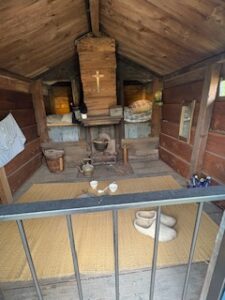 In this photo, take a gander at the “bedrooms” (up top, near ceiling). They are so small because people slept sitting up. They believed if you self laying down, blood would go to your head and you would die! Those poor people!
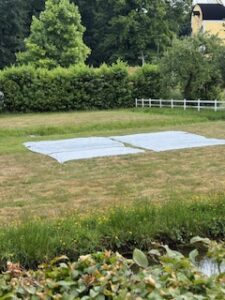
Laundry was put out on the lawn to dry. It took 30 days to process a load of laundry and so the laundry was done only once every six months and only the wealthy got their laundry done.
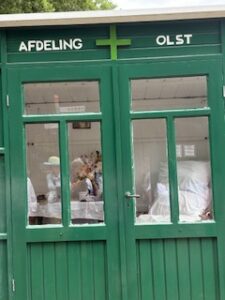
If you took ill, you could lie in this single-room building which was on a turn-style. The building moved to follow the sun so you’d always lie in the sun while you got better. How lovely!
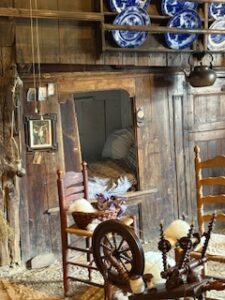
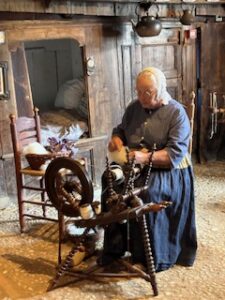 This spinner gave us a live demonstration on how she turned sheep’s wool into yarn.
It was an enlightening day in Nijmagen. I am eternally grateful to the Industrial Revolution and the modern-day Bill Gates and Steve Jobs for bringing us the wonders of technology.
Thank you, Netherlands. It’s been a slice!